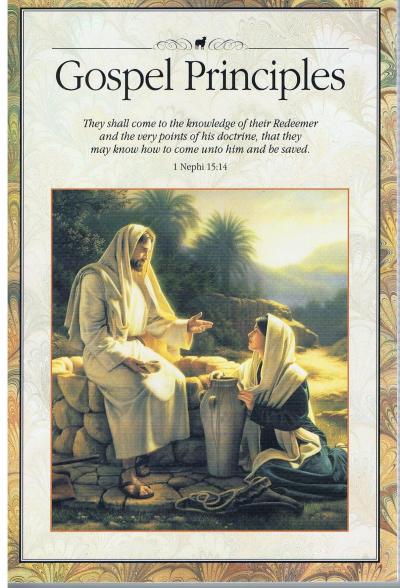
Our friends at Mormonism Research Ministry have put together an exposition of some of the notable changes made to the Gospel Principles manual between 1978 and 2009
"The study [IRR] posted was excellent! I read thru and was amazed. By far the best analysis of LDS priesthood vs. what the Bible says about Priesthood. Jesus truly is the Great High Priest, we have no need of any other!" - G.
A chapter-by-chapter look at the Mormon Church manual that is now being used by Latter-day Saints for Melchizedek Priesthood and Relief Society sessions around the world.
Mormons around the world are studying the newest edition (2009) of the LDS manual, Gospel Principles. This page provides links to the LDS manual as well as a chapter-by-chapter study guide for understanding the subjects covered in light of the Bible. It also features other resources that directly relate to the LDS Gospel Principles manual.
Contrary to popular misunderstanding, Jesus Christ did not establish an organization. He founded his church (Matthew 16:18), but the church is not an organization. Jesus created no organizational hierarchy, instituted no organizational structure, and left no organizational blueprint for others to follow. He gave the church no official name (referring to it simply as “my church”). The church is instead a covenant community—an association of people who publicly gather together under the terms of the “new covenant” that Jesus Christ made between God and humanity through his sacrificial death on the cross. Despite LDS insistence to the contrary, there was no total apostasy of Christ's church. (Also available in a PDF version)
Covenant Theology is a critical part of interpreting both Mormonism and Christianity. Starting with the Abrahamic Covenant, one must take a careful look at God's covenants with his people, and the important differences between LDS covenant theology and historical Biblical covenant theology. (Also available in a PDF version)
The idea of priesthood offices and the roles determined by them are integral to the hierarchy and structure of the LDS church. However, when compared to the bible both in function and in principle, one can see that the LDS concept of priesthood offices and roles differs greatly from the same roles and their function in the biblical context. (Also available in a PDF version)
The LDS conception of priesthood represents a rejection of the biblical teaching that God is the absolutely unique Creator in whom all power eternally and intrinsically resides. Rather than viewing the personal Creator God who has revealed himself in Jesus Christ as the ultimate, eternal Power, LDS doctrine identifies as that ultimate Power an impersonal force called "the Priesthood" that both Heavenly Father and Jesus Christ attained through a process of exaltation. (Also available in a PDF version)
Did Jesus really bleed from every pore in Gethsemane? Was this what paid for our sins? In Mormon theology, does the atonement guarantee eternal life for anyone? Mormons and Christians share important terms that relate to forgiveness and eternal life, but define and understand these terms in radically different ways. This article explores these key concepts that define our eternal destiny. (Also available in a PDF version)
There is probably no topic or doctrine like that of the person and work of Jesus Christ in which there is so much agreement and disagreement between the LDS and biblical Christian teachings. In this chapter we look at extensive points on both sides, as well as how the LDS Church justifies making changes to the historic and biblical teachings on Jesus Christ. (Also available in a PDF version)
Is the LDS view that the Bible is corrupted and untrustworthy a fair and accurate assessment? Did Joseph's changes to the Bible restore parts that were lost from the original manuscripts? In this response to GP chapter 10 we provide an overview and short evaluation of each of the major Mormon scriptures and how they compare to one another and the Bible. (Also available in a PDF version)
In this response to chapter 9 we look at the Mormon teaching on prophets. Are they truly necessary today? Can we trust that a Mormon prophet will never lead the church astray? Also available as a Quick-Look: Chapter 9 - Prophets short, bullet-point summary of what's covered in the longer article.
A short, bullet-point summary of what's covered in the longer article. What the chapter on Prophets gets right, and what it gets wrong.
In this article, we examine what the Bible says about praying to and worshipping Jesus Christ, and consider what God must be like—and what the Bible says he is like—in order to hear and answer prayer.
In this response to chapter 7 of the LDS manual Gospel Principles, we compare LDS teaching about the Father, Son, and Holy Ghost to the Bible’s teaching, and focus especially on the issues of the identity, indwelling, and witness of the Holy Ghost.
This article discusses the Mormon doctrines about Adam and the Fall and compares them to the Bible. It answers questions about whether Adam is the Ancient of Days or Michael the Archangel.
The complete Gospel Principles manual in various formats.
A complete list of all the chapters of the Gospel Principles Study Guide
Elohim and Jehovah (Yahweh) - if they are two separate Gods, as the Mormon Church teaches, why are these two Hebrew words used interchangeably throughout the Old Testament and why are they used together to refer to the same Supreme Being?
The answer may surprise you. Here's a complete list that you can read on screen, store to your hard drive, or print out.